Jake's Take: Inside the Madness
3/8/2002 10:30:40 AM | Men's Basketball
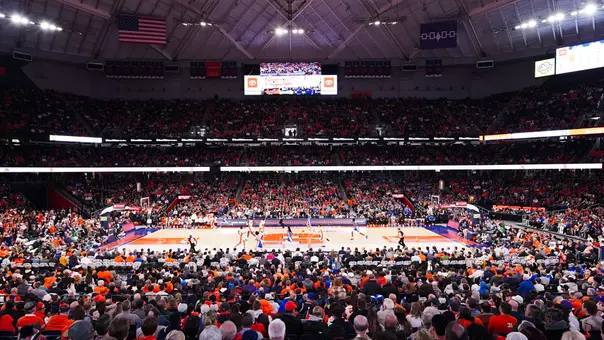
March and its basketball madness are upon us once again, and, as in the year 2000 NCAA Men?s Basketball Tournament, the East Regional champion will be crowned in the Carrier Dome and move on to the Final Four in Atlanta. Since my six-year stint on the NCAA Men's Basketball Committee, this time of year always resurrects a degree of nostalgia as I reflect back on a process that is entrusted to ten individuals who are responsible for putting together one of the greatest sporting events in the world each year. Selection Sunday tips it off, but the tournament is a year round undertaking.
As a member of the Basketball Committee, preparation for selection Sunday starts in December and runs through early March. This time is spent studying game results from coast to coast, who beat who, who lost to whom, home or away, injuries or suspensions, conference standings, etc. Just as you begin to develop a comfort level with what you know, the conference tournaments begin and inevitably there are upsets. Those upsets, particularly by teams who otherwise would not have been projected to make the tournament, can be devastating to some teams on the bubble. During this two-month period you lose all perspective of how huge the tournament has become and the impact you have on it.
The Starting Point
During the selection meetings of the Men's Basketball Committee it is more of the same exercise except that there is input and analysis from others. Collectively, decisions are made on individual teams, beginning with a list prepared by each committee member of all the teams they think must be in the tournament. In order to pass this first test a team must receive all but two votes from the committee. Since each member represents a different conference across the country, only the elite teams pass this muster so you may begin with only 8-10 teams on board.
Once the automatic qualifiers are added to the board, the exercise gets intense. Who are the other deserving teams, and how many slots remain. The committee has tons of detailed information at hand, and can call up computer comparisons (nitty-gritty) of specific teams in a matter of seconds which include overall won/loss record, strength of conference schedule, strength of non-conference schedule, record and scores vs. top 1-25, 26-50, 51-100, 101-150, etc. ranked teams, home and away record, last 10 games, etc. At this point in the process every team begins to look the same because, in most cases, they are. One win here or loss there can tip the scale for a team on the bubble. Added to the equation is an unstated, but understood, sensitivity to the number of teams from any one conference that make the field of 64, and since 2001, a field of 65.
Planting the Seeds
Once the field is set, the seeding begins. Perhaps the toughest two lines to fill are the number 1 and 2 seeds. A substantial amount of time is spent on the top line (#1 seeds) because just about everything else in the process is driven by that determination. The #1 seeds are given the advantage in terms of geographic consideration. The second seeds are critical as well because of the advantage given the #1 seeds. You need to make sure that no second seed should be a first seed. The difference between being the fourth first line seed and the first second line seed is huge. While the remainder of the seeding process is critical, it is not quite as critical. For example, the winner of the game vs. the 8 vs. 9 seed plays the #1 seed in the second round. Thus, being seeded 8 or 9 is not that critical. The same goes for the 4 and 5 seeds. If there are no early round ?upsets?, that winner plays the #1 seed in the regional semifinal. The #2 and #3 seeds play one another in the regional semifinal, assuming no ? upsets?, so once the #1 seeds are firmly established, being #2 or #3 isn?t that critical.
Placing a team in a particular region is not by chance. There are protocols that must be followed. The #1 seeds remain in their region unless there are two teams from the same area, e.g., Stanford and Arizona. If Stanford is the lower #1 seed, then Arizona will stay in the West and Stanford will be moved to another region. A team cannot play any tournament game in a facility in which it played more than half its home games, e.g., Syracuse in the Dome. In the first round no one is to play a team it played during the regular season. Some teams can?t play on Sunday because of religious observances so they must be placed in a Thursday/Saturday bracket. A team should not be moved out of its region if in its latest NCAA appearances it was moved out (some teams, like Georgetown under Big John, prefer to play as far away from their region as possible, and this flexibility is considered). No more than one team from any conference can be seeded #1, 4/5, 8/9, 12/13 or 16 in the same bracket. No more than one team from any conference can be seeded #2/3, 6/7, 10/11 or 14/15 in the same bracket. This prevents two teams in the same conference from playing one another until the regional final, but it also affects the geographic location. The lowest seeded teams are usually kept close to their geographic region because they are not expected to win. Other teams may be moved out of their natural region to balance the strength in another region. All of these factors are taken into consideration in the bracketing and may, in fact, result in changing a team?s true seed (up or down one line) just to make it all work. This exercise is to create four regional brackets that are equal in strength. Inevitably, the public and the pundits will analyze them and determine which regions are the strongest and weakest.
A New Twist
This year a new concept is being introduced in assigning teams to first/second round playing sites. In the former bracketing process, once teams were seeded in a particular region, they played their first/second round games in that region, the winners moving onto the Regional in that same region. In the new procedure, each of the top four seeds (16 teams) are still seeded in a region, but their first/second rounds sites may be in a different region, using geography as much as possible in their placement. To make this work, each of the eight first/second round sites will host any two of the top 16 seeds. Previously, the number one and four seeds always played at the same first/second rounds sites as did the two and three seeds. Now, to accommodate geography, as long as there are two teams at each first/second round site from among the top 16 seeded teams, it doesn?t matter how they are seeded. In fact, two #1 seeds could play at the same first/second round site. Once the winners are determined, they move on to their predetermined regional site which may have been different from the region in which their first/second round took place. Using the above example of Stanford and Arizona, both teams stay in the west and play in Sacramento or Albuquerque, the first/second round sites in the West region. In fact, both teams could play at the same site in the opening rounds. Assuming both teams won their first/second round games, Stanford would then move out to its preassigned region and Arizona would stay west. This will be an interesting process to watch. It will certainly result in the top 16 seeded teams playing closer to home in the first/second round games, which is the intended purpose, but will sure scramble the field for those early rounds.
Game Time
As a result of this intense exercise, the tournament is ready to begin. For the committee members, whatever perspective remained of your impact on the tournament at the start of four intense days of meeting is totally gone by adjournment. Rather than relief, you fear that despite the detail, something was missed somewhere in the process that eliminated certain teams while others were included; that you seeded one team too high or another too low. Then you travel to your first/second round site, and suddenly it all unfolds before your eyes. Eight teams and their coaches are there. All the tickets have been sold. The arena looks great. Hoards of media are organized and accommodated. CBS is rolling. The hotels are full. And it is only then that you begin to realize that you have been an integral part of staging one of the greatest sporting events in the world. That realization is both humbling and heady. It was the most fantastic experience in my professional life.