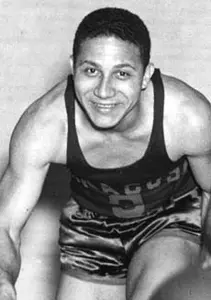
Wilmeth Sidat-Singh
SU to Honor A Pioneer -- Wilmeth Sidat-Singh
2/24/2005 8:00:16 AM | Men's Basketball, Football
One of the greatest student-athletes in Syracuse University history, Wilmeth Sidat-Singh ’39 was also an individual of extraordinary courage. Sidat-Singh starred for the Orange football and basketball squads, despite being subjected to racial bias. After earning his degree in zoology from SU, Sidat-Singh played professional basketball. The NFL ban on African-American players eliminated pro football as an option.
On Feb. 25, Syracuse University’s Office of Program Development, the Office of the Chancellor and Syracuse University Athletics will honor the memory of Sidat-Singh, his family and members of the Tuskegee Airmen, with a private reception prior to the ceremony retiring Singh’s #19 jersey at halftime of the Syracuse men’s basketball game against Providence on Feb. 26. The ceremony will include members of Sidat-Singh’s family, including his aunt, Adelaide Henley, her sons, Benjamin Henley, Lyn Henley, and her daughter-in-law, Barbara Henley. In addition Lt. Col. Clarence Dart, a Tuskegee Airman and member of 332 Fighter group, John Schroeder, Sidat-Singh’s teammate on the 1936, 1937, 1938 and 1939 basketball team, John Isaacs, a boyhood friend and Harlem Renaissances teammate, Roger Mabie, a 1939 SU football team manager, Syracuse University Chancellor and President Nancy Cantor, SU Director of Athletics Dr. Daryl Gross, SU Assistant Vice President for Program Development Larry Martin, and Post-Standard columnist Sean Kirst will celebrate Sidat-Singh’s legacy.
 In 1943, Sidat-Singh passed the entrance exam for the U.S. Army Air Corps and was assigned to the segregated armed forces’ only pilots training program for African Americans: the Tuskegee Airmen. Just days after earning his pilot’s wings, Sidat-Singh was on a training mission, when the engine of his P-40 failed, forcing him to parachute into Lake Huron. His body was found a week later. First Lieutenant Wilmeth Sidat-Singh, U.S. Army Air Corps, is buried at Arlington National Cemetery.
“Wilmeth Sidat-Singh was a pioneer in everything that he did,” Martin said. “He was a remarkable individual, a two-sport star and an outstanding student. Until now, his story has only been known to a few.”
An All-New York City basketball player at DeWitt Clinton High School, Sidat-Singh led his Bronx team to the Public School Athletic League (PSAL) city championship in 1933-34. Despite his talent and credentials, Syracuse University was the only school to offer him a scholarship. At SU, the six-foot, 190-pound Sidat-Singh led the Orange to three straight winning seasons.
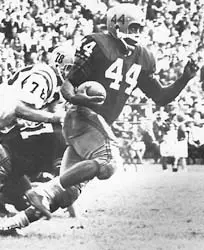
A hero and leader on campus, Sidat-Singh also joined the football team in his sophomore year after assistant coach Roy Simmons Sr. spotted him throwing a 55-yard pass, flat-footed, in an intramural game. He was subject to the indignities plaguing many African-Americans when the Orange traveled to southern states to play. Officials from some of the schools SU traveled to play prevented Sidat-Singh from playing, citing segregation laws. He was banned from the 1937 game at Maryland, which the Orange lost 13-0. One year later, when the teams met in Archbold Stadium, Sidat-Singh helped SU to a 53-0 triumph against the Terrapins. He played halfback in Syracuse’s single-wing offense, a position similar to today’s quarterback.
In an article for The Syracusan magazine, Don Hallock ’38 described the pre-med zoology major as “an omnivorous reader…more interested in a sheepskin than a pigskin.”
Sidat-Singh’s Syracuse football teammates included Hugh “Duffy” Daugherty ’39, the storied head coach at Michigan State, and Marty Glickman ’39, the radio voice of New York City sports for half a century. In 1938, legendary sportswriter Grantland Rice came to Syracuse to scout Rose Bowl-bound Cornell. After watching Sidat-Singh engineer a stunning 19-17 upset for Syracuse — including six passes for 150 yards and 3 touchdowns in the final 9 minutes — Rice ranked Sidat-Singh with Sid Luckman and Sammy Baugh, the greatest throwing arms of the era.
After graduation, Sidat-Singh played with the Syracuse Reds, one of the few racially integrated professional basketball teams of the barnstorming era. On December 1, 1939, the Reds defeated the Original Celtics 40-37 in Watertown, New York. Sidat-Singh scored 14. A year later, he joined the Harlem Renaissance (or “Rens”), the most famous of the African American barnstorming teams.
Sidat-Singh was born Wilmeth Webb, the son of Elias Webb, a Washington pharmacist, and Pauline Webb. Both of his parents were African Americans. Elias Webb died when Wilmeth was a child. Pauline Webb then married Dr. Samuel Sidat-Singh, then a medical student who had come to the United States to study at Howard University. Dr. Sidat-Singh adopted Wilmeth and moved the family to West 135th Street in Harlem, where he practiced family medicine for many years.



Sunday, October 18
Sunday, October 18
Sunday, October 18
Sunday, October 18