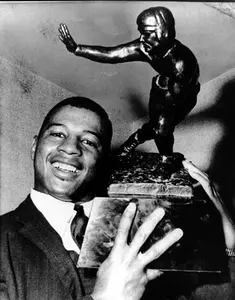
Syracuse's Ernie Davis won the 1961 Heisman Trophy. The NCAA reconginzed his accomplishment as part of its centennial celebration.
SU's Davis Honored by NCAA for His Historic Accomplishment
2/16/2006 1:04:01 PM | Football
In honor of its 100th anniversary, the NCAA has selected the "25 Defining Moments in NCAA History." Former Syracuse University running back Ernie Davis becoming the first African-American student-athlete to win the Heisman Trophy earned recognition on the NCAA’s list.
Davis, who is the only SU football student-athlete to win the Heisman trophy, led the Orange to the 1959 National Championship, scoring two touchdowns in the 1959 Cotton Bowl victory against Texas. He broke Jim Brown’s SU career rushing record and closed his career by leading the Orange to a Liberty Bowl win against Miami. He is currently ninth on Syracuse’s career rushing yards record list with 2,386 yards.
Davis, who was inducted into the College Football Hall of fame in 1979, was the first overall selection in the 1961 NFL Draft by the Washington Redskins. He was traded to the Cleveland Browns where Paul Brown hoped to team Davis in a dream backfield with the man whose records Davis had broken at Syracuse – NFL rushing king Jim Brown. The dream never came to be. Davis died of leukemia in 1963, a wonderful and beloved young man stricken down in the prime of his life.
ESPN Classic and ESPNU are airing those moments throughout the months of January, March and September. Each moment is a 30-second vignette that highlights the most exciting, important and memorable events in the NCAA's history. The vignettes began airing January 2 on ESPN Classic and ESPNU.
The "25 Most Defining Moments in NCAA History" were chosen by a special panel that included college presidents, athletics directors, faculty representatives, student-athletes and conference representatives as the top moments that best represent the NCAA's 100-year history.
The NCAA celebrates is 100th anniversary in 2006.
The "25 Most Defining Moments in NCAA History"
* The NCAA is founded in 1906 after a warning from President Theodore Roosevelt to either reform or risk the abolition of football.
* Presidential firsts: Palmer Pierce becomes the Association's first president, holding office from 1906 to 1913 and from 1917 to 1929. On January 12, 1981, James Frank of Lincoln (Missouri) becomes the first black and the first college president elected to serve as membership president of the NCAA. On January 10, 1991, Judy Sweet becomes the first woman to serve as membership president of the NCAA. The NCAA began calling its executive director "president" following the NCAA reorganization in 1997 that eliminated the elected membership president position.
* The first NCAA championship is held June 17-18, 1921, at Chicago when student-athletes from 62 colleges and universities compete in track and field.
* Ohio State's Jesse Owens breaks four world records at the 1935 Big Ten Conference track championships.
* The first men's basketball championship is held at Northwestern on March 27, 1939.
* Walter Byers is named as the Association's first excecutive director in 1951. A national headquarters is established in Kansas City, Missouri, in 1952. Richard Schultz succeeds Byers after his retirement in 1987. Cedric Dempsey becomes the Association's third president back in 1994, followed by Myles Brand.
* Oklahoma football student-athlete Prentice Gautt becomes the first African-American student-athlete to play for a member institution in the Jim Crow states of the South and Southwest in 1956. Gautt later becomes the NCAA's secretary-treasurer in 1994.
* Syracuse running back Ernie Davis becomes the first African-American student-athlete to win the Heisman Trophy in 1961.
* Loyola (Illinois) faces Mississippi State in a 1963 men's basketball tournament regional semifinal. Mississippi State, an all-white team, sneaks out of town in the middle of the night despite protests from the governor and state police of Mississippi to play a Loyola team that features four black starters. Mississippi State overcame an unwritten Mississippi rule against playing integrated teams with a cloak-and-dagger flight to the North just one step ahead of a court injunction. Loyola beats Mississippi State and goes on to win the title.
* On June 19, 1965, UCLA senior Arthur Ashe wins the 1965 NCAA singles and doubles titles and leads the Bruins to a team championship.
* On March 19, 1966, Texas Western and its five African-American starters defeat Kentucky 72-65.
* On March 15, 1973, Dacia Schileru, a Wayne State (Michigan) diver, becomes the first woman to compete in an NCAA championship, entering the College Division Swimming and Diving Championships.
* The UCLA men's basketball team wins a seventh straight NCAA title in 1973.
* The 1979 Final Four championship game, featuring Earvin "Magic" Johnson from Michigan State University and Larry Bird from Indiana State University, earns the highest TV rating (24.1) of any title game before or since.
* Delegates at the 75th annual Convention in 1981 adopt a governance plan to include women's athletics programs and services within the NCAA structure.
* In what many believe is the greatest Cinderella story in college basketball, North Carolina State's Lorenzo Charles dunks the ball as time expires in the 1983 championship game to lead the Wolfpack to a 54-52 win over heavily favored Houston.
* Boston College quarterback Doug Flutie's "Hail Mary" touchdown pass to Gerard Phelan lifts the Eagles over Miami (Florida) in 1984.
* North Dakota State wins a fourth straight Division II Women's Basketball Championship in 1996. The four-year run includes a perfect season in 1994-95 and a 49-game winning streak, one of the longest in NCAA history.
* Marymount basketball student-athlete Corinne Carson becomes one of the first known collegiate athletes to return to the sport after a liver transplant. She is named the WBCA National Player of the Year in Division III for 1997.
* The NCAA and CBS Sports in 1999 reach an 11-year, $6 billion agreement for television, radio, Internet, corporate marketing, licensing, publishing, home video and Hoop City rights for the Division I men's basketball championship.
* Simpson wrestler Nick Ackerman, who does not have the use of his legs, wins the championship match in the 174-pound class at the 2001 Division III Wrestling Championships.
* Iowa State wrestler Cael Sanderson completes his four-year undefeated collegiate career by winning the championship match in the 197-pound class at the 2002 Division I Wrestling Championships.
* UCLA Pitcher Keira Goerl throws a nine-inning no-hitter in the 2003 NCAA Division I Softball Championship Game.
* In 2003, North Carolina wins the NCAA Division I Women's Soccer Championship for the 18th time (in the past 23 seasons) while finishing the season undefeated at 27-0.
* Tennessee women's basketball coach Pat Summitt leads her Lady Vols past Purdue in the 2005 NCAA tournament to become the all-time winningest coach in NCAA basketball history.
Highlights | Women's Lacrosse at #4 Northwestern
Friday, March 13
Regy Thorpe Postgame Press Conference vs. #4 Northwestern
Friday, March 13
Press Conference | Men's Lacrosse at Air Force
Friday, March 13
Highlights | Syracuse at Air Force
Thursday, March 12