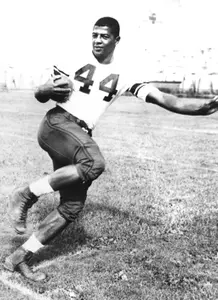
Ernie Davis became the first African-American to win the Heisman Trophy 50 years ago today.
A Historic Moment 50 Years Ago Today
12/6/2011 8:34:09 PM | Football
By Scott Pitoniak
Floyd Little was a student at Bordentown Military School in New Jersey that early December day in 1961 when he heard the news that Ernie Davis had won the Heisman Trophy as college football's most outstanding player. The man who would one day follow in Davis' cleat steps at Syracuse University could barely contain his joy because he believed this was a watershed event not just for sports, but also for America. For the first time in the 27-year history of this prestigious award, the voters had chosen an African-American as its winner. And the significance of that moment resonated deeply with Little, who just so happened to be the first black to attend Bordentown.
“I was elated for Ernie, I was elated for me and I was elated for all African-Americans who aspired to live in a country where opportunities were available to all, regardless of race,” recalled Little, who became a three-time football All-American for the Orange before embarking on a remarkable career as a professional football player and entrepreneur that came full circle when he returned to his alma mater this year as a special assistant to Athletics Director Dr. Daryl Gross.
“My thinking was that another barrier had come tumbling down at a time when many barriers still existed. And it really hit home with me because of my standing as the only black at Bordentown. It was one of those moments in my life when I started thinking that maybe one day the American Dream might be attainable to all Americans.”
Syracuse University will celebrate the 50th Anniversary of Davis becoming the first African-American to win the Heisman Trophy on Friday, December 9 in New York City. The special event will honor Davis for his impact on and off the field with a program featuring historic sports figures.
To commemorate the event, Vice President Joseph R. Biden (Law '67) will deliver remarks. Following his remarks, there will be a film tribute to Ernie Davis and a panel discussion addressing the evolution of diversity and equal rights in athletics.
The Master of Ceremonies for the evening will be Marv Albert '61, a classmate of Davis' at Syracuse. The panel discussion, “Breaking Barriers, Building Dreams: The Landmark Achievement of Ernie Davis,” will be moderated by sportscaster Len Berman. Participants will include: Dave Bing '66, Mayor of Detroit and Basketball Hall of Fame inductee; Frank Deford, Hall of Fame sportswriter, author and commentator; Mike Garrett, the second African-American to win the Heisman Trophy; Billy Hunter '65, Executive Director of the NBA Players Association; Floyd Little '67, College and Pro Football Hall of Fame inductee; and Art Monk '80, Pro Football Hall of Fame Inductee.
Bing, a contemporary of Little at SU who would achieve enormous success as a basketball player, businessman and humanitarian, experienced similar feelings of hope and pride when he heard the news about Davis' Heisman victory. That it occurred during a time when segregation was still rampant in America and three years before the passage of the Civil Rights Act was not lost on him.
“You really have to view it in the context of the times,” said Bing, the current mayor of Detroit. “These were tumultuous times as far as race relations in America were concerned. Martin Luther King Jr. and the Civil Rights Movement were just picking up steam and segregation was becoming the dominant social issue in our country. So, for Ernie to win a prestigious award at a time when African-Americans were still second-class citizens in many parts of the United States was a big, big deal.”
Davis' Heisman victory, coupled with a second-place finish by another African-American, Bob Ferguson of Ohio State, were clear indications, to quote Bob Dylan, that the times they were a-changing. Ernie's door-opening achievement would pave the way for Mike Garrett of the University of Southern California to become the second black winner in 1965, followed by USC's O.J. Simpson in 1968 and Nebraska's Johnny Rodgers in 1972. From 1974 through 1983, African-Americans would win the Heisman 10 consecutive times. In the 50 years since Davis broke the barrier, African-Americans have captured the most prestigious individual award in all of college sports 28 times.
“I really believe Ernie's achievement has been kind of underplayed by history,'' Little said. “Yes, the movie (The Express) from a few years ago shed a little light on his remarkable life and the racial discrimination that he overcame with great courage and dignity. But I still don't believe Ernie has gotten his full due as an historical figure. In many ways, he was like Jackie Robinson. He didn't fight back and get angry the way most of us would have if we had faced what he did. That wasn't Ernie. Even though that stuff hurt him deeply, he opted to let his actions speak for him. On and off the field.”
Many believe that another Syracuse great, Jim Brown, should have been the first African-American to win the award five years earlier, but was denied the honor because of the racial biases of the sportswriters and sportscasters who voted. And there had been other talented black players before him – Ollie Matson, Buddy Young and Dick Bass – who also turned in Heisman-worthy seasons.
“I guess, for whatever reason – and I'll leave it up to others to decide what those reasons were – America wasn't ready for a black man to win the Heisman until Ernie,'' Brown said in a 2008 interview. “All I know is that you couldn't have chosen a more deserving player and human being than Ernie Davis. He was a gifted but modest guy who had a tremendous concern for his fellow man. He had such a kind soul that I think he transcended race. I really believe Ernie had a way of making you look beyond the color of his skin and into depth of his soul. He was special.”
Both Bing and Little will second that emotion. Davis, who broke most of Brown's school rushing records while leading Syracuse to the national championship in 1959, played a role in the recruitment of each of them. And although their encounters with him were few, Davis clearly made an indelible impression on them that dramatically changed their lives.
SU basketball was the dregs when Bing was being recruited out of Spingarn High School in Washington, D.C. The Orange as just a year removed from a then-Division I-record 27-game losing streak and the fact Coach Fred Lewis was able to convince him to choose SU over 200 other schools is regarded as one of the greatest recruiting upsets in college basketball history. Give a huge assist to Lewis, who smartly asked Davis to be one of Bing's chaperones during his campus visit in the spring of '62. “I was clearly awestruck,'' Bing recalled. “I had a chance to speak to him at length . . . He was honest and frank. He told me about the good experiences and the bad experiences he had at SU. I walked away thinking, 'What an impressive human being.” And I thought that if SU could help develop a human being like Ernie Davis, then I wanted to go there and try to follow in his footsteps. The way he handled himself on and off the field with such dignity, set a standard, I believe for everyone at Syracuse to follow. I remember when I was getting ready to leave campus that weekend, he told me I had an opportunity to be the 'Ernie Davis of basketball.' That was the clincher for me.”
Interestingly, Davis' recruitment of Little wasn't as clear-cut. In fact, Little initially was leaning toward another New York State school – the United States Military Academy at West Point. During Little's senior year at Bordentown, famed Gen. Douglas MacArthur invited him to dinner at the Waldorf-Astoria in Manhattan. The World War II hero pulled out all stops that night, inviting Elston Howard, the first African-American to play for the New York Yankees, along with former Brooklyn Dodgers legend Roy Campanella. MacArthur talked about how Little could follow in the tradition of legendary Army running backs Don Blanchard and Glenn Davis, who combined to win back-to-back Heismans in the late 1940s. But the most appealing pitch came when MacArthur told that Little had the potential to become the first African-American general. “I was really into the military lifestyle at the time, so that really struck a chord with me,” Little said. “I look back on that and I chuckle. Just think, I could have become Colin Powell and David Petraeus' boss.”
Not long after that memorable night, Davis and Syracuse Coach Ben Schwartzwalder paid a visit to Little's home in New Haven, Conn. They took the recruit to a swank restaurant on the campus of Yale University, and before dinner was served, Davis and Little paid a visit to the men's room, where they chatted for close to a half-hour. “I was very, very impressed with Ernie – how could you not be?” Little recalled. “But after awhile, I was getting hungry. I had never had steak and lobster and I wanted badly to get back to our table before our meal got cold. So, to speed things up, I told Ernie that I would be going to Syracuse. The strange thing is that when I got back home that night my mind hadn't really changed at all. As impressive and nice as Ernie had been to me, in my heart I was still going to West Point.”
It wasn't until several months later, on May 18, 1963, that Little changed his mind. On that day, just 17 months after hearing the joyous news of Davis' Heisman triumph, Little learned that Ernie had died of leukemia at age 23. “I was like, 'You're kidding me. It can't be true,'” he recalled. “I didn't even know he was sick. And at that moment I remembered that I had given Ernie my word that I was going to Syracuse and a man's word is the most valuable thing he has. So, I picked up the phone and called Coach Schwartzwalder to tell him I would be attending Syracuse University. It wound up being one of the greatest decisions of my life.”
Bing also remembers receiving the shocking news – he was finishing up his freshman year at Syracuse at the time – and being moved in the same manner that Little had.
“It left a huge hole in me,” he said. “You see this guy, who's only a few years older than you – a big, strapping athlete who's been drafted first overall by the Cleveland Browns and has this sky's-the-limit NFL career and life ahead of him – and in a snap he's gone. At that age, you take for granted that you are going to live a full life and a great life. Then, you hear about something like that and it really smacks you in the face. At that point, I made a conscious decision to dedicate my career to Ernie. Not only was I going to make sure that I didn't squander an ounce of my ability on the court, but that I was going to try to be the kind of ambassador and humanitarian that Ernie had been.”
And the same was true for Little.
“No question, I was going to live my life in tribute to him,” he said. “I was going to honor Ernie by attempting to live a full life, a dedicated life, a life Ernie didn't get a chance to live.”
Davis, undoubtedly would have been flattered by their gestures and proud of what they've achieved, not only in sports, but beyond.
Around campus, Davis' presence is everywhere – from the life-sized statue near Hendricks Chapel to the Heisman Trophy in Iocolano-Petty Football Wing of Manley Field House to the dormitory named in his honor on Comstock Avenue to the huge No. 44 jersey he, Brown and Little made famous that hangs from the Carrier Dome rafters.
But the greatest presence can be found in the lives lived by the men who were swayed to follow him to Syracuse – two young African-Americans who felt a sense of pride and hope when they learned that Davis had become the first black to win the Heisman.
“I think Dave and I and so many others who've followed are living proof of what a significant event that was,” Little said. “That wasn't just some guy winning the Heisman Trophy 50 years ago. That was a person of color. Another barrier fell that day at a time when more barriers were beginning to fall. And a half century later the impact of that particular barrier falling is still being felt.”
Floyd Little was a student at Bordentown Military School in New Jersey that early December day in 1961 when he heard the news that Ernie Davis had won the Heisman Trophy as college football's most outstanding player. The man who would one day follow in Davis' cleat steps at Syracuse University could barely contain his joy because he believed this was a watershed event not just for sports, but also for America. For the first time in the 27-year history of this prestigious award, the voters had chosen an African-American as its winner. And the significance of that moment resonated deeply with Little, who just so happened to be the first black to attend Bordentown.
“I was elated for Ernie, I was elated for me and I was elated for all African-Americans who aspired to live in a country where opportunities were available to all, regardless of race,” recalled Little, who became a three-time football All-American for the Orange before embarking on a remarkable career as a professional football player and entrepreneur that came full circle when he returned to his alma mater this year as a special assistant to Athletics Director Dr. Daryl Gross.
“My thinking was that another barrier had come tumbling down at a time when many barriers still existed. And it really hit home with me because of my standing as the only black at Bordentown. It was one of those moments in my life when I started thinking that maybe one day the American Dream might be attainable to all Americans.”
Syracuse University will celebrate the 50th Anniversary of Davis becoming the first African-American to win the Heisman Trophy on Friday, December 9 in New York City. The special event will honor Davis for his impact on and off the field with a program featuring historic sports figures.
To commemorate the event, Vice President Joseph R. Biden (Law '67) will deliver remarks. Following his remarks, there will be a film tribute to Ernie Davis and a panel discussion addressing the evolution of diversity and equal rights in athletics.
The Master of Ceremonies for the evening will be Marv Albert '61, a classmate of Davis' at Syracuse. The panel discussion, “Breaking Barriers, Building Dreams: The Landmark Achievement of Ernie Davis,” will be moderated by sportscaster Len Berman. Participants will include: Dave Bing '66, Mayor of Detroit and Basketball Hall of Fame inductee; Frank Deford, Hall of Fame sportswriter, author and commentator; Mike Garrett, the second African-American to win the Heisman Trophy; Billy Hunter '65, Executive Director of the NBA Players Association; Floyd Little '67, College and Pro Football Hall of Fame inductee; and Art Monk '80, Pro Football Hall of Fame Inductee.
Bing, a contemporary of Little at SU who would achieve enormous success as a basketball player, businessman and humanitarian, experienced similar feelings of hope and pride when he heard the news about Davis' Heisman victory. That it occurred during a time when segregation was still rampant in America and three years before the passage of the Civil Rights Act was not lost on him.
“You really have to view it in the context of the times,” said Bing, the current mayor of Detroit. “These were tumultuous times as far as race relations in America were concerned. Martin Luther King Jr. and the Civil Rights Movement were just picking up steam and segregation was becoming the dominant social issue in our country. So, for Ernie to win a prestigious award at a time when African-Americans were still second-class citizens in many parts of the United States was a big, big deal.”
Davis' Heisman victory, coupled with a second-place finish by another African-American, Bob Ferguson of Ohio State, were clear indications, to quote Bob Dylan, that the times they were a-changing. Ernie's door-opening achievement would pave the way for Mike Garrett of the University of Southern California to become the second black winner in 1965, followed by USC's O.J. Simpson in 1968 and Nebraska's Johnny Rodgers in 1972. From 1974 through 1983, African-Americans would win the Heisman 10 consecutive times. In the 50 years since Davis broke the barrier, African-Americans have captured the most prestigious individual award in all of college sports 28 times.
“I really believe Ernie's achievement has been kind of underplayed by history,'' Little said. “Yes, the movie (The Express) from a few years ago shed a little light on his remarkable life and the racial discrimination that he overcame with great courage and dignity. But I still don't believe Ernie has gotten his full due as an historical figure. In many ways, he was like Jackie Robinson. He didn't fight back and get angry the way most of us would have if we had faced what he did. That wasn't Ernie. Even though that stuff hurt him deeply, he opted to let his actions speak for him. On and off the field.”
Many believe that another Syracuse great, Jim Brown, should have been the first African-American to win the award five years earlier, but was denied the honor because of the racial biases of the sportswriters and sportscasters who voted. And there had been other talented black players before him – Ollie Matson, Buddy Young and Dick Bass – who also turned in Heisman-worthy seasons.
“I guess, for whatever reason – and I'll leave it up to others to decide what those reasons were – America wasn't ready for a black man to win the Heisman until Ernie,'' Brown said in a 2008 interview. “All I know is that you couldn't have chosen a more deserving player and human being than Ernie Davis. He was a gifted but modest guy who had a tremendous concern for his fellow man. He had such a kind soul that I think he transcended race. I really believe Ernie had a way of making you look beyond the color of his skin and into depth of his soul. He was special.”
Both Bing and Little will second that emotion. Davis, who broke most of Brown's school rushing records while leading Syracuse to the national championship in 1959, played a role in the recruitment of each of them. And although their encounters with him were few, Davis clearly made an indelible impression on them that dramatically changed their lives.
SU basketball was the dregs when Bing was being recruited out of Spingarn High School in Washington, D.C. The Orange as just a year removed from a then-Division I-record 27-game losing streak and the fact Coach Fred Lewis was able to convince him to choose SU over 200 other schools is regarded as one of the greatest recruiting upsets in college basketball history. Give a huge assist to Lewis, who smartly asked Davis to be one of Bing's chaperones during his campus visit in the spring of '62. “I was clearly awestruck,'' Bing recalled. “I had a chance to speak to him at length . . . He was honest and frank. He told me about the good experiences and the bad experiences he had at SU. I walked away thinking, 'What an impressive human being.” And I thought that if SU could help develop a human being like Ernie Davis, then I wanted to go there and try to follow in his footsteps. The way he handled himself on and off the field with such dignity, set a standard, I believe for everyone at Syracuse to follow. I remember when I was getting ready to leave campus that weekend, he told me I had an opportunity to be the 'Ernie Davis of basketball.' That was the clincher for me.”
Interestingly, Davis' recruitment of Little wasn't as clear-cut. In fact, Little initially was leaning toward another New York State school – the United States Military Academy at West Point. During Little's senior year at Bordentown, famed Gen. Douglas MacArthur invited him to dinner at the Waldorf-Astoria in Manhattan. The World War II hero pulled out all stops that night, inviting Elston Howard, the first African-American to play for the New York Yankees, along with former Brooklyn Dodgers legend Roy Campanella. MacArthur talked about how Little could follow in the tradition of legendary Army running backs Don Blanchard and Glenn Davis, who combined to win back-to-back Heismans in the late 1940s. But the most appealing pitch came when MacArthur told that Little had the potential to become the first African-American general. “I was really into the military lifestyle at the time, so that really struck a chord with me,” Little said. “I look back on that and I chuckle. Just think, I could have become Colin Powell and David Petraeus' boss.”
Not long after that memorable night, Davis and Syracuse Coach Ben Schwartzwalder paid a visit to Little's home in New Haven, Conn. They took the recruit to a swank restaurant on the campus of Yale University, and before dinner was served, Davis and Little paid a visit to the men's room, where they chatted for close to a half-hour. “I was very, very impressed with Ernie – how could you not be?” Little recalled. “But after awhile, I was getting hungry. I had never had steak and lobster and I wanted badly to get back to our table before our meal got cold. So, to speed things up, I told Ernie that I would be going to Syracuse. The strange thing is that when I got back home that night my mind hadn't really changed at all. As impressive and nice as Ernie had been to me, in my heart I was still going to West Point.”
It wasn't until several months later, on May 18, 1963, that Little changed his mind. On that day, just 17 months after hearing the joyous news of Davis' Heisman triumph, Little learned that Ernie had died of leukemia at age 23. “I was like, 'You're kidding me. It can't be true,'” he recalled. “I didn't even know he was sick. And at that moment I remembered that I had given Ernie my word that I was going to Syracuse and a man's word is the most valuable thing he has. So, I picked up the phone and called Coach Schwartzwalder to tell him I would be attending Syracuse University. It wound up being one of the greatest decisions of my life.”
Bing also remembers receiving the shocking news – he was finishing up his freshman year at Syracuse at the time – and being moved in the same manner that Little had.
“It left a huge hole in me,” he said. “You see this guy, who's only a few years older than you – a big, strapping athlete who's been drafted first overall by the Cleveland Browns and has this sky's-the-limit NFL career and life ahead of him – and in a snap he's gone. At that age, you take for granted that you are going to live a full life and a great life. Then, you hear about something like that and it really smacks you in the face. At that point, I made a conscious decision to dedicate my career to Ernie. Not only was I going to make sure that I didn't squander an ounce of my ability on the court, but that I was going to try to be the kind of ambassador and humanitarian that Ernie had been.”
And the same was true for Little.
“No question, I was going to live my life in tribute to him,” he said. “I was going to honor Ernie by attempting to live a full life, a dedicated life, a life Ernie didn't get a chance to live.”
Davis, undoubtedly would have been flattered by their gestures and proud of what they've achieved, not only in sports, but beyond.
Around campus, Davis' presence is everywhere – from the life-sized statue near Hendricks Chapel to the Heisman Trophy in Iocolano-Petty Football Wing of Manley Field House to the dormitory named in his honor on Comstock Avenue to the huge No. 44 jersey he, Brown and Little made famous that hangs from the Carrier Dome rafters.
But the greatest presence can be found in the lives lived by the men who were swayed to follow him to Syracuse – two young African-Americans who felt a sense of pride and hope when they learned that Davis had become the first black to win the Heisman.
“I think Dave and I and so many others who've followed are living proof of what a significant event that was,” Little said. “That wasn't just some guy winning the Heisman Trophy 50 years ago. That was a person of color. Another barrier fell that day at a time when more barriers were beginning to fall. And a half century later the impact of that particular barrier falling is still being felt.”

Head Coach Fran Brown Press Conference | Spring Ball Day 8
Wednesday, April 01
Dwight Freeney at FRANCHISE Coaches Clinic
Monday, March 30
Donovin Darius at FRANCHISE Coaches Clinic
Monday, March 30
John Scott Jr. Press Conference | Spring Ball Day 5
Saturday, March 28