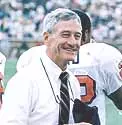
The Crouthamel Era: 25 Years of Excellence
4/29/2003 12:27:40 PM | Men's Basketball, Football
A: I had foolishly resigned at Dartmouth as head football coach. I was not fired, I resigned without a job. It was the dumbest thing I've ever done in my life. I would never ever do that again. I was at Dartmouth for 13 years, six as an assistant coach and seven as the head coach and I went there as an undergraduate. I didn't see spending the rest of my life at Dartmouth. I really didn't aspire to coach at this kind of level (Division IA), and didn't want to move down. I figured I had to force myself to do what I want to do which is be an athletic director at a level like this. Coincidentally, the Syracuse position was open then. When I told my wife that we were moving, she made me promise that we would be here only four years and then we would move. I don't know to where, and that was 25 years ago."
Q: Is it easier today for a coach to make the move to an administrative position such as athletic director?
A: "I think it's harder for a coach to make that move now because the profession has changed so dramatically in the past 20 years. What used to be the old boy network, that is when you retired as the head men's basketball coach or head football coach you became the AD, those situations are not happening anymore. There's a recycling, probably more now than years ago, of ADs. The ADs are moving around. You go from Nebraska to Texas A&M for example. That's a little new, too."
Q: Why do some athletic directors leave schools to go other schools that are similar in size?
A: "I've felt this for quite some time that change is good, if for no other reason than change because it forces you to re-look and re-assess what you have been doing, what you should be doing. I think institutionally, it's good, as well, to get fresh people, new ideas. Not that that's always the case, because a great deal of being fresh is the staff that surrounds you. We've been very, very fortunate here in that we've got young, aggressive, bright, creative people. They've kept me going. It's not me keeping them going."
Q: In a profession where people change jobs quite frequently, your staff has been very stable. What factors do you think have contributed to this?
A: "I want to emphasize that you are only as good and able to accomplish anything as the people that surround you. We've been very fortunate to be able to attract and sustain a very stable staff. I don't know why that is because there are a lot of other very fine athletic programs around the country that would benefit tremendously from the quality of staff that we have. Yet, we have not had to replace many people. Obviously that shows a great deal of loyalty to the institution and the program. The program is the beneficiary of that."
Q: What are the most significant changes have you seen in the department in the last 25 years?
A: "Everything has changed so dramatically. I was hired as the director of "men's" athletics. It was us guys out here. Now we have 12 women's teams. We have facilities that are really quite good and very efficiently maintained and used. When I was offered the job, I was promised that we would have for the '80 football season, a 50,000-seat outdoor stadium at Skytop. During that summer, very quietly, Chancellor Mel Eggers was working with some politicians in Albany and the concept changed from a 50,000-seat open-air stadium at Skytop to the Carrier Dome. After that commitment was made, then it was hustling to sell the boxes and sell preferred seats which, quite frankly, wasn't all that difficult because it was so unique. People wouldn't have to sit out in freezing rain to watch football. But the opportunity to do what we were able to do was a direct result of the Dome in several different ways. For the first five years, which was the commitment that the preferred seat holders made, all of that contribution went to paying off our portion of the Dome construction. After that period of time, all of that money came back to the athletic department. After 10 years, that was true with the boxes. As a result of that new income and the attendance we had in the building, we were able to do some things from a capital projects standpoint, which is basically what you see now. It educated our public to what a big-time athletic program is really all about. Prior to the Dome, our community thought a big-time program was a schedule only, and required nothing else. The Dome educated our public that in order to play a big-time schedule, you have to be big-time in other things and other areas. The Dome really helped to change the mentality of the community."
Q: What do you think would be the biggest surprise about running an athletic department for fans?
A: "Cost. We are continually looked at as being money-hungry, rich, we have all of this money and we're raising ticket prices. I think that if people really understood what it costs to run a program like this, and the income that the program generates, they would be very surprised."
Q: For many years Syracuse led the nation in men's basketball attendance. Did you foresee that happening?
A: "When we were building the Dome, we never even thought about basketball being played in the Dome. It was only after we got to the stage where the contractors said "We're going to lay the artificial turf. What do you want under it?" It was only then, practically after the whole thing was built, that we said we could play basketball here. Jim (Boeheim) was resistant. He had the friendly confines of the Manley Zoo. We were packing them in. It was really only reluctantly that he agreed to move. He wouldn't move out of the Dome now."
Q: What have been the biggest changes you've seen in college athletics?
A: "Probably two things. One is the building war that is going on. When one school in a major conference builds something, everyone else has to follow suit. The other thing is the absolute commitment to national prominence and being No. 1. Not that it wasn't like that before, but it didn't exist as widely as it does now. That's all based on money. Everything we are doing in intercollegiate athletics at this level is because of money. Not that we need more to put in the endowment, we need to cover our expenses so we're not in the hole. And this whole notion of being over-commercialized, which is one of the cries from the presidents around the NCAA, is because there aren't many of us who are operating in the black. So how do you get more money other than to commercialize it. I guess the notion is that we don't care if you break even or make money, if you lose money, we'll underwrite it. That's OK if that is what higher education wants to do and is being done for close to 70 percent of the Division IA schools. These are institutional decisions, not athletic department decisions. The notion that we in intercollegiate athletics are the reason that athletics is where it is now, is not by chance. If the presidents are concerned, where were they 20 years ago. They were still there. The fact that athletics was allowed to basically operate independent of the institution without a lot of oversight is clear indication that was what the institution wanted to do. Now we're paying the consequences."
Q: Do you have an accomplishment during your time that you would rank as No. 1?
A: "The obvious is the '87 men's basketball season and the '87 football season when we went to the Final Four and the Sugar Bowl, ironically both in the same building. I recall very vividly the season after the '87 season in basketball, we were ranked No. 1 in the early part of the season. I was sitting in the Dome watching football and men's basketball practicing. Football was practicing for the bowl and basketball was practicing at the same time. I'm looking out there, and I look to my left and say 'There's the No. 1 team in the country' and to my right and say 'There's the No. 4 team in the country'. That's kind of neat, particularly for Syracuse. In men's lacrosse, we were bad when I first got here. Five years later we were National Champions with all local kids."
Q: After all of these years, do you still look forward to gameday?
A: "I sure do. The old coach in me has never left. I start getting my game face on about five to six hours before the game, regardless of the game. On game day, I'm not a pleasant person to be around. That's the coach in me I guess."
Q: Can you talk about the formation of The BIG EAST Conference?
A: "The first year in the conference, we played here in Manley in1979 and then we moved to the Dome in '80. The conference thing was quite an experience - the process of forming the conference and deciding who was going to be in it. There were basically four of us. Dave Gavitt was at Providence, Frank Rienzo was at Georgetown, Jack Kaiser at St. John's and myself really selected the membership and got the thing going. Dave was really the architect of the thing. That was really quite an accomplishment. We sort of take those things for granted. Under the circumstances, it was quite an accomplishment. That original conference has been asked, almost required in certain cases, to make accommodations which is why we're at 14 members now, which is really too many. When you look at where we came from, from a television standpoint, we were doing our own television then. The conference was doing its own syndication. We became good enough as a conference competitively that we became valuable property. We were really the first conference in the country that contracted with ESPN. We really got ESPN into the business back then. Now it dominates the business."
Q: What do you see as the future of college athletics?
A: "I do see it being more of a have-have not game. The people with money are going to spend it, which is evident in this building war. And they are going to attract the cream of the crop. The rest of us are going to survive, if we choose to survive, on the basis of institutional support, not a whole lot of other support. If you're not able to compete with the best, then interest is going to wane. When you look at salaries being paid to head coaches, only people with money can afford to pay those salaries. I don't know how they got where they are, but I think it's really unfortunate that they are where they are. But these become business decisions which is in fact what we are in. We are not in intercollegiate athletics, we are in the business of entertainment. That's really been one of the changes as well."
Q: What do you want to do when you retire from SU?
A: "I've been thinking more about that recently for obvious reasons. When I retire from the University, the first thing I will probably do is look for a job - not as an athletic director. I don't know what as, but look for a job."