Meet My Friend Jocelyn
10/7/2024 1:09:00 PM | Women's Soccer
More Than A Game
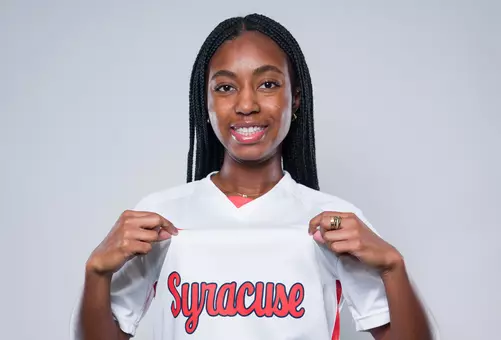
Somehow, life brought Syracuse soccer student-athlete Kendyl Lauher and Jocelyn Homer together at exactly the right time. Kendyl had suffered an injury that ended her 2023 season while Jocelyn and her family were trying to navigate the challenge of selective mutism. Kendyl and Jocelyn connected and a special friendship emerged. Here is Kendyl's story about Jocelyn.
Following the conclusion of the gymnastics meet, Jocelyn patiently awaited the results, hoping her performance throughout the day was enough to earn her a spot on the podium.
She anxiously picked at her new calluses, courtesy of the uneven bars. With somewhere around 200 sets of eyes on her, she enthusiastically trotted over to claim her medal for second place in the all-around competition. Jocelyn's mother, Renee Homer, fondly recalled the moment, stating, "It was the first time I felt like, 'Okay we got this,' and that there is happiness within her."
Selective Mutism?
Ten-year-old Jocelyn Homer is part of the one percent of the population that suffers from an obscure mental disorder known as selective mutism. Even as a special education teacher, Renee had never heard of the condition prior to her daughter's diagnosis. While selective mutism is rare, there is one desire that remains consistent among all those afflicted with mental disorders, disabilities, or developmental delays, and that is inclusivity.
One environment where those battling these conditions have been able to feel like they belong most is within the world of sports. Whether it be watching, playing, coaching, or commentating, sports have consistently proven to positively impact those who often walk through life feeling like an outsider.
To protect these children, parents often restrict them from participating in recreational activities and sports with their peers which ultimately widens the gap between their capabilities and that of their non-disabled peers. Health care professionals urge parents to allow their children with disabilities to participate fully — or as much as they are capable — in athletics, recreation, and physical activities.
The list of benefits includes reversing deconditioning secondary to impaired mobility, optimizing physical functioning, and enhancing overall well-being. Regular physical activity is essential for the maintenance of normal muscle strength, flexibility, and joint structure and function and may slow the functional decline often associated with disabling conditions.
Learning the Diagnosis
Being a triplet born prematurely, Jocelyn's challenges began early in life. Her first few weeks earth side were spent in a neonatal intensive care unit (NICU). Fast forward Jocelyn attending Pre-K, behavioral issues and persistent migraines prompted a family trip to Rochester, N.Y., for a consultation with a neurologist. Tests eventually led them to schedule a neuropsychological evaluation after referral. Upon meeting with Jocelyn for only a few hours, doctors were very certain with a diagnosis of selective mutism, a cognitive anxiety disorder that renders children speechless.
Selective mutism is debilitating as children miss opportunities to connect with others, are unable to meet important life milestones, and cannot ask for help when necessary. Feelings of excitement or joy are often non-existent or not made apparent to others.
Due to the rarity of the disorder, the Homer family continues to learn and adapt to the challenges brought on by selective mutism each day. Medicine and treatments have contributed to Jocelyn's improvements, but nothing can be accredited for these advancements more than sports.
Sports Opens A Window For Jocelyn
When it comes to sports, Jocelyn is truly a jack of all trades -- you name it, she's probably tried it. Her current favorite activity is flag football. Ask her in a week and she'll probably give you a different answer — maybe lacrosse or soccer.
Her mother describes Jocelyn as having natural athleticism and the ability to figure out anything new that is thrown at her. She doesn't usually have a lot of confidence in most regards, but she knows her athleticism exceeds that of most girls her age, and it's something Jocelyn takes pride in.
Jocelyn's self-assurance within sports is a complete contrast to how she feels in essentially every other facet of her life. When it's dinner time at the Homer household, Jocelyn will often eat on the stairs or in a separate room so that she isn't obligated to draw attention to herself by eating in front of everyone else. Conversely, on the field, court, or in the gym, she wants all eyes on her and has learned to appreciate standing out because of her inherent athletic ability.
Similarly, there have been countless occurrences of Jocelyn coming home from school with a fever or not feeling well, but she was unable to speak up to let her teachers know she was sick. This inability to express herself vocally has also resulted in multiple bathroom accidents because her selective mutism affected her ability to ask to use the restroom. Jocelyn is learning to utilize her voice within an athletic setting, becoming more comfortable with talking to teammates and coaches.
A large factor within this newly instilled confidence comes from positive feedback and reinforcement from her coaches and peers. Rene Homer could not emphasize enough how important this was. This validation has provided Jocelyn with opportunities to feel a deeper connection with the kids also participating in these sports.
The Benefits of Inclusivity
For those who think there's no advantage for non-disabled kids collaborating with disabled individuals, the evidence states otherwise. Kids have a natural instinct to help or speak up for those who cannot, a quality that adults often find difficult. The result is an entire group of kids — or teammates in this matter — growing and developing together.
Dr. Sara DuMond, a board-certified pediatrician working to enhance the lives of children each day, has seen these improvements through sports firsthand.
"For neuro-divergent kids, participation in sports can be incredibly beneficial," DuMond says. "We know that playing a sport or participating in a similar group activity not only decreases anxiety, relieves stress, and improves focus, but it also allows these kids to build social and emotional bridges to their neuro-typical peers. That sets them up for future success in other areas of their lives going forward, both cognitively and relationally."
While her background is inspiring, kids like Jocelyn Homer should not only be used as a motivational story about their battles overcoming adversity. Stories like hers can be utilized to continue to normalize inclusivity for all those coming from diverse backgrounds, and sports is certainly the place to do it.
Programs like TOPSoccer through the U.S. Youth Soccer Organization or individual club initiatives to merge children of varying degrees of functioning should become ordinary, globally.
So, kids, aim high no matter what. And parents, don't let societal norms encourage you to hold your child back. Sports — in any capacity — are for everyone. Whether it's on the team in the heat of the action, or one of the many roles surrounding play, the spirit of competition and accomplishment is rewarding for all.
Following the conclusion of the gymnastics meet, Jocelyn patiently awaited the results, hoping her performance throughout the day was enough to earn her a spot on the podium.
She anxiously picked at her new calluses, courtesy of the uneven bars. With somewhere around 200 sets of eyes on her, she enthusiastically trotted over to claim her medal for second place in the all-around competition. Jocelyn's mother, Renee Homer, fondly recalled the moment, stating, "It was the first time I felt like, 'Okay we got this,' and that there is happiness within her."
Selective Mutism?
Ten-year-old Jocelyn Homer is part of the one percent of the population that suffers from an obscure mental disorder known as selective mutism. Even as a special education teacher, Renee had never heard of the condition prior to her daughter's diagnosis. While selective mutism is rare, there is one desire that remains consistent among all those afflicted with mental disorders, disabilities, or developmental delays, and that is inclusivity.
One environment where those battling these conditions have been able to feel like they belong most is within the world of sports. Whether it be watching, playing, coaching, or commentating, sports have consistently proven to positively impact those who often walk through life feeling like an outsider.
To protect these children, parents often restrict them from participating in recreational activities and sports with their peers which ultimately widens the gap between their capabilities and that of their non-disabled peers. Health care professionals urge parents to allow their children with disabilities to participate fully — or as much as they are capable — in athletics, recreation, and physical activities.
The list of benefits includes reversing deconditioning secondary to impaired mobility, optimizing physical functioning, and enhancing overall well-being. Regular physical activity is essential for the maintenance of normal muscle strength, flexibility, and joint structure and function and may slow the functional decline often associated with disabling conditions.
Learning the Diagnosis
Being a triplet born prematurely, Jocelyn's challenges began early in life. Her first few weeks earth side were spent in a neonatal intensive care unit (NICU). Fast forward Jocelyn attending Pre-K, behavioral issues and persistent migraines prompted a family trip to Rochester, N.Y., for a consultation with a neurologist. Tests eventually led them to schedule a neuropsychological evaluation after referral. Upon meeting with Jocelyn for only a few hours, doctors were very certain with a diagnosis of selective mutism, a cognitive anxiety disorder that renders children speechless.
Selective mutism is debilitating as children miss opportunities to connect with others, are unable to meet important life milestones, and cannot ask for help when necessary. Feelings of excitement or joy are often non-existent or not made apparent to others.
Due to the rarity of the disorder, the Homer family continues to learn and adapt to the challenges brought on by selective mutism each day. Medicine and treatments have contributed to Jocelyn's improvements, but nothing can be accredited for these advancements more than sports.
Sports Opens A Window For Jocelyn
When it comes to sports, Jocelyn is truly a jack of all trades -- you name it, she's probably tried it. Her current favorite activity is flag football. Ask her in a week and she'll probably give you a different answer — maybe lacrosse or soccer.
Her mother describes Jocelyn as having natural athleticism and the ability to figure out anything new that is thrown at her. She doesn't usually have a lot of confidence in most regards, but she knows her athleticism exceeds that of most girls her age, and it's something Jocelyn takes pride in.
Jocelyn's self-assurance within sports is a complete contrast to how she feels in essentially every other facet of her life. When it's dinner time at the Homer household, Jocelyn will often eat on the stairs or in a separate room so that she isn't obligated to draw attention to herself by eating in front of everyone else. Conversely, on the field, court, or in the gym, she wants all eyes on her and has learned to appreciate standing out because of her inherent athletic ability.
Similarly, there have been countless occurrences of Jocelyn coming home from school with a fever or not feeling well, but she was unable to speak up to let her teachers know she was sick. This inability to express herself vocally has also resulted in multiple bathroom accidents because her selective mutism affected her ability to ask to use the restroom. Jocelyn is learning to utilize her voice within an athletic setting, becoming more comfortable with talking to teammates and coaches.
A large factor within this newly instilled confidence comes from positive feedback and reinforcement from her coaches and peers. Rene Homer could not emphasize enough how important this was. This validation has provided Jocelyn with opportunities to feel a deeper connection with the kids also participating in these sports.
The Benefits of Inclusivity
For those who think there's no advantage for non-disabled kids collaborating with disabled individuals, the evidence states otherwise. Kids have a natural instinct to help or speak up for those who cannot, a quality that adults often find difficult. The result is an entire group of kids — or teammates in this matter — growing and developing together.
Dr. Sara DuMond, a board-certified pediatrician working to enhance the lives of children each day, has seen these improvements through sports firsthand.
"For neuro-divergent kids, participation in sports can be incredibly beneficial," DuMond says. "We know that playing a sport or participating in a similar group activity not only decreases anxiety, relieves stress, and improves focus, but it also allows these kids to build social and emotional bridges to their neuro-typical peers. That sets them up for future success in other areas of their lives going forward, both cognitively and relationally."
While her background is inspiring, kids like Jocelyn Homer should not only be used as a motivational story about their battles overcoming adversity. Stories like hers can be utilized to continue to normalize inclusivity for all those coming from diverse backgrounds, and sports is certainly the place to do it.
Programs like TOPSoccer through the U.S. Youth Soccer Organization or individual club initiatives to merge children of varying degrees of functioning should become ordinary, globally.
So, kids, aim high no matter what. And parents, don't let societal norms encourage you to hold your child back. Sports — in any capacity — are for everyone. Whether it's on the team in the heat of the action, or one of the many roles surrounding play, the spirit of competition and accomplishment is rewarding for all.

Players Mentioned

D
/ Women's SoccerSyracuse WSOC Highlights vs Duke
Friday, October 24
Syracuse WSOC Highlights vs Boston College
Sunday, October 19
Syracuse Women's Soccer
Sunday, October 19
Syracuse Highlights vs Miami
Sunday, October 12